
Student Living Made Simple
Student Living is not complicated; don’t overthink it. Living and teaching fundamental principles of love, responsibility, respect, kindness, honesty, cooperation, and forgiveness is Student Living. Make Student Living a daily part of your work.
- What made these apartments special?
- What principles and/or values did you see in action?
- What is your role in helping residents create this type of apartment?
- How can you more strongly exemplify the principles of Student Living?
- How can you show more love to your residents in natural and simple ways?
- How can you inspire your residents to show love to their roommates and others?
- How can you follow the Savior’s example to be a better leader and manager?
Your Influence As A Manager
Teaching residents is inherent in the daily life of a manager. In the simplest of ways, your words and actions can significantly influence residents.
Watch the following videos and ponder these questions:
- How does Student Living contribute to my purpose as a manager?
- How do I make Student Living a natural part of my daily work?
- How can I measure my influence on residents?


Resolving Conflicts





The following videos discuss dealing with conflict.
Ponder the insights given and consider how you can apply these principles to conflicts that arise.
Building a Student Living Culture
- In what ways am I already promoting principles of Student Living?
- How can I set the example of Student Living as a manager
- How can I implement Student Living in natural ways?
Managers have a unique opportunity to create and foster a warm and inviting culture at their complex. An approved housing complex should be a place where students feel valued and respected.
The following videos show Student Living in action. What can you do as a manager to encourage this way of life?


As you build a Student Living culture, consider these five steps:
What Are Student Living Meetings?
This is an introductory meeting at the start of the semester, sometimes also called Welcome Meetings. The purposes of the meetings are as follows and should guide how to organize and communicate the meeting to your residents.
- Introduce your management team to your residents and have an opportunity to mingle with them.
- Teach students how to be successful as roommates and residents at your property. See the Content section.
- Share important property information.
Considerations for your Student Living Meetings
Your knowledge of the information and conviction will set the tone for the culture of your complex and will support positive interactions with your residents throughout the semester. Spend the time necessary praying and preparing for your meeting. Seek inspiration each semester by asking, “How can I support the mission of BYU-Idaho and most effectively help students who live at my property to become disciples of Jesus Christ?” That should guide what you share and how you share it.
- Send information in your Welcome email prior to the semester check-in.
- Post signs throughout the property, on doors, elevators, or on their fridge.
- Send email reminders and post on social media.
- Send a text reminder the day before then again, an hour before the meeting.
- Apartment visits:
- beneficial to meet nearly all residents early in the semester,
- be in their space and observe interactions among roommates,
- effect in sharing information, especially ESA guidelines, etc.,
- relationship building among roommates and with management,
- personalized invitations and follow-up are more effective,
- provide resources like roommate council sheets, etc.,
- can be done with any size of property; just allow 10 minutes minimum.
- Small groups (12-25)
- match up apartments by proximity, HE groups, building, floor, etc.
- builds friendships/community,
- allows for in-depth discussions,
- may be more conducive to sharing media/videos, etc.
- activities are easier to conduct and more effective.
- Large groups (strive for less than 75)
- most time efficient up front, but may lead to more time spent later covering materials or resolving concerns that were not discussed deeply in the meetings,
- can be effective if broken into smaller discussion groups which allow for interaction and questions to be shared in more personal ways,
- will require more follow-up to ensure understanding,
- may benefit from including ecclesiastical leaders and dividing by ward.
- New students and returning residents
- allows you to share the most pertinent information with new residents and a review with returning residents in different ways,
- helps new residents find friendships among other new residents,
- ability to use returning residents to teach or present to new residents or inviting returning residents to mentor and support new roommates,
- allows emphasis on the new student experience, could include New Student Mentors, etc.,
- provides an opportunity for returning residents to lead deeper discussions, strengthen and share the positive complex culture, and even get involved in planning events.
- Think about what you wish you would have known earlier in your own college experience about living with roommates, passing clean checks, getting involved, etc. and build your plan around those things. If you have not been a student at BYU-Idaho, ask a few of your returning residents what would be helpful.
- Make it a meeting the residents would not want to miss because they find it practical, inspirational, and helpful.
- Student Living – sharing resources of how to live well with roommates. Making it feel like home, a place that is comfortable, and supportive. This includes effective communication at the start of the semester (roommate councils), getting to know one another and building relationships, working to peacefully resolve concerns within the apartment.
- It also should emphasize one or more of the principles of being a Covenant Keeper, Leader @ Home, and Peacemaker.
- See Student Living Outlines for ideas.
- Share resources from The Roommate Guide.
- Apartment Living Standards and Student Honor – identifying basic guidelines that help all students to keep their commitments, live their covenants, and thrive while attending BYU-Idaho. This should be a positive look at how these guidelines help students to be successful, reduce conflict in their apartments, and become stronger disciples.
- Property rules and reminders like office hours, submitting maintenance, use of amenities, trash protocol, clean checks, etc.
- The intent is to build better relationships, set the tone for positive and frequent communication with management and with neighbors in their complex community.
- Asking good questions! This is key to a successful discussion
- Read this article about asking good questions.
- The Roommate Guide
- The Student Living Guidebook
- Student Living Videos
- Develop a list of common scenarios that occur in the apartment. Come up with questions to facilitate discussion of how to navigate them.
- The following have strong Student Living messages or select one of your choice. Relate the message to Student Living principles in their personal lives, relationships with others, and at BYU-Idaho.
- Peacemakers Needed – President Russell M. Nelson
- Covenant Keeping Disciple Leaders – President Alvin F. Meredith
- Covenant Confidence – Elder Ulysses Soares
- The Merciful Obtain Mercy – Elder Deiter Uchtdorf
- Careful vs. Casual – Sister Becky Craven
- Blessed are the Peacemakers – Elder Gary Stevenson
Tips for Success and Best Practices
Choose one or more of the following ideas to give your meetings, and your students, a boost. Adding some of these elements leads to more successful meetings and more peaceful semesters for them . . . and you.
- It should feel like a family council – not a reprimand or threats of punishment or charges for student behaviors – keep it positive and interactive.
- Come up with a plan with your management team of what your residents need for that semester. Choose a Student Living emphasis for the whole semester.
- Show a video or do a fun activity to support that principle.
- Create a grocery bingo game
- Make a packet for each apartment with pertinent information, deliver the packets to each apartment during the first week and visit with them about how to build relationships with roommates.
- Choose a theme for the semester and focus your meeting as well as emails and activities throughout the semester on this same theme.
- Example: Growth – tie it to personal growth as well as developing relationships with others.
- Disciple leaders @ home – reaching out and helping roommates, getting involved and supporting one another.
- Set up a Google link for all apartments with majority Freshmen sharing information important to the complex and their experience at BYU-Idaho and allow them to ask question. Then set up a time to meet to discuss how to have a roommate council, setting goals, creating appropriate boundaries, communication as roommates, etc.
- Have food! A few ideas from several properties include:
- Match a men’s apartment with a women’s apartment, give one apartment one element of the meal (spaghetti) and the other (bread and salad). Give them a list of topics to cover from property information to roommate relationships.
- Provide food and divide into groups to discuss scenarios that happen commonly within an apartment and consider how to resolve them.
- Have food following the meeting: pizza, subs, potato bar, bbq sandwiches, walking tacos, chocolate fountain, soda bar, cookies, etc.
- Create a flyer of key things to post on their fridges like how to submit a maintenance request, reserving amenities, etc.
- Put a roommate council sheet on their fridge and if they have a council before the first clean check and have posted goals, reward them. Ideas for rewards:
- Tickets to do something together as an apartment, like a campus event or concert, play, or comedy show.
- Pizza and soda
- Brownie box
- Free Pass from a clean check
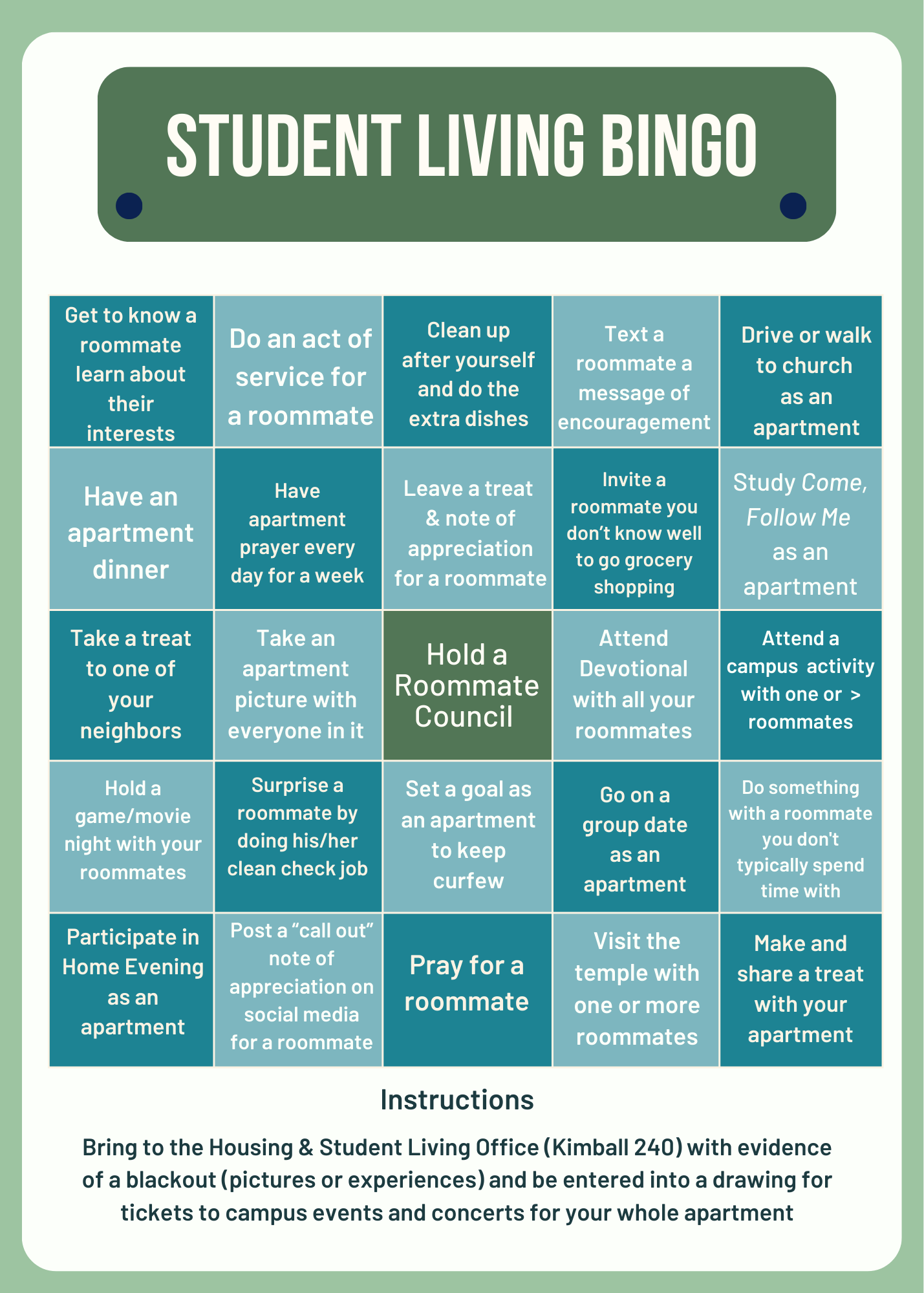
- Have a fun activity they can do for the semester or at least the next week.
- Roommate Bingo
- Property scavenger hunt - finding things online or on the property – how to submit a maintenance request, reserve an amenity, or visit and take a picture of the workout facility, etc.
- Share a calendar of campus and community events happening all semester for students to get involved with roommates. Spending time together will build relationships and reduce conflict.
- Encourage students to get involved. You could even sponsor a Campus Rec. Team for volleyball, basketball, softball, ultimate frisbee, etc. from the property – even get matching t-shirts.
Additional Student Living Resources


